
We have partnered with THCB to provide excerpts from the 2nd edition of the Handbook, which will provide background and insight on important health care issues that we face today. We would love your questions, comments and feedback. Today’s excerpt provides a brief overview of the state of the US health care system today.
Cost
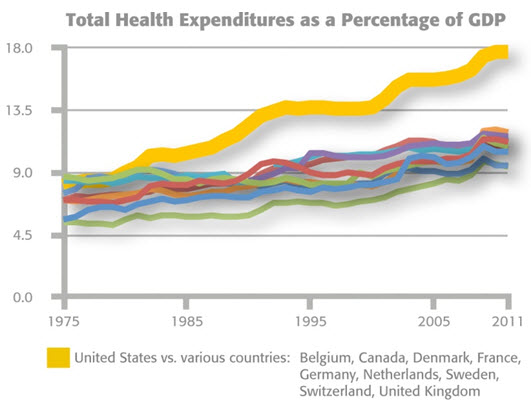
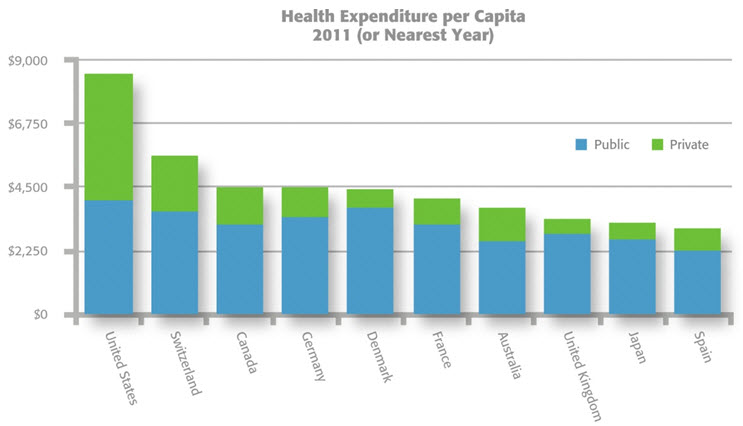
The U.S. currently spends more than 17% of its national gross domestic product (GDP) on health care, far more than any other country in the world. Health care spending now averages almost $9,000 per American,1and health care is the fastest growing industry in the country.2Private (nongovernmental)health care spending accounts for a large portion of the difference between spending in the U.S. and in other industrialized countries.
Access
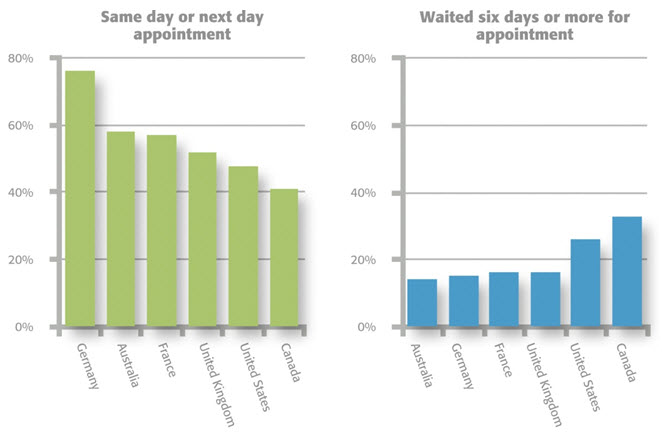
The U.S. has fewer physicians,hospital beds, physician visits,and hospitalizations per capita than most other industrialized countries.3 Eighty-five percent of Americans report having a regular source of ongoing care, but more than a quarter encounter difficulty accessing the healthcare system.4 There are large disparities in access by type of health insurance coverage.
Agency for Healthcare Research and Quality, “2012 National Healthcare Quality and Disparities Reports,” June 2013. Note: Health insurance status refers to those 18–64 years old. Poor refers to household incomes below the federal poverty level (FPL); low income, 100–200% FPL; middle, 200–399% FPL; high, more than 400% FPL.

The Commonwealth Fund, “2013 International Health Policy Survey in Eleven Countries,”Nov. 2013. Used with permission.
Quality
Despite spending all that money, we don’t have the highest quality health system.Americans only receive about 55–70% of recommended care they need,4,5and huge disparities exist in health outcomes by insurance status, race, income,and location.6 Life expectancy is rising, but not as fast as in other industrialized countries. The U.S. ranks poorly for infant and maternal mortality, preventive care, and chronic disease care. On the bright side, we’re near the front of the pack in cancer care, medical research and education, and diagnostic imaging.3
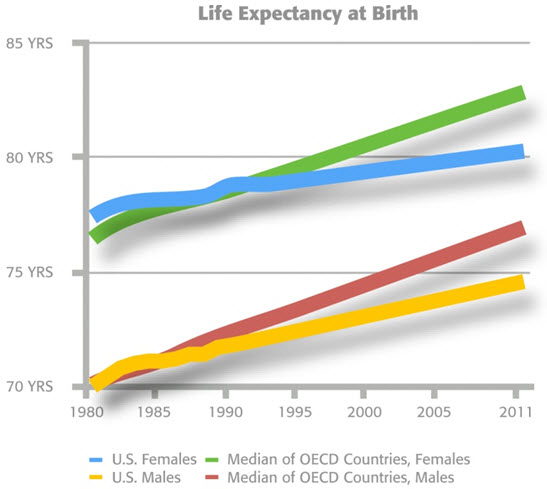


Organisation for Economic Co-operation and Development,“Health Statistics 2013,” June 2013.Other Countries noted here include:Australia, Austria, Belgium, Canada, Chile,Czech Rep., Denmark, Finland, France,Germany, Greece, Iceland, Ireland, Israel,Italy, Japan, Korea, Luxembourg, Netherlands,New Zealand, Norway, Poland, Portugal,Slovak Rep., Slovenia, Spain, Sweden,Switzerland, United Kingdom. Data for Japan and Australia refers to 2008.Note: Values in U.S. $ Purchasing Power Parity.
Any way you slice it, the U.S. health care system is in trouble. The most recent major international comparison by the Commonwealth Fund ranked our system 11th—which isn’t so bad until you realize that the study only included eleven countries.
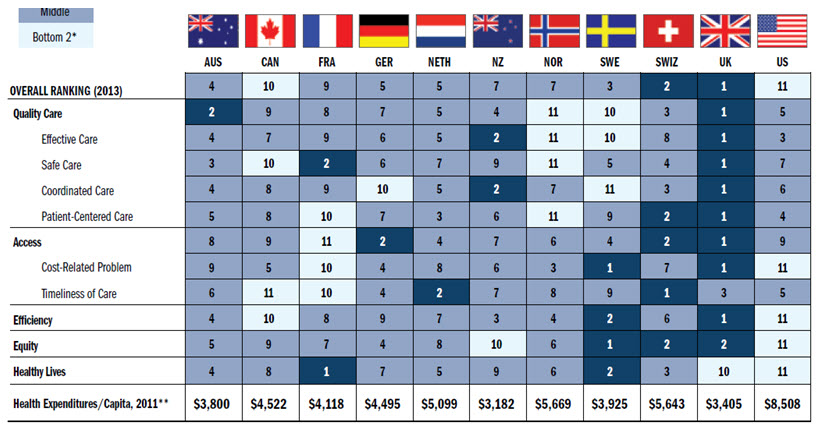
Davis, et al., “Mirror, Mirror on the Wall, 2014 Update: How the U.S. Health Care System Compares Internationally,”The Commonwealth Fund,June 2010. Used with permission.
1 NHE Fact Sheet. www.cms.gov/Research-Statistics-Data-and-Systems/Statistics-Trendsand Reports/NationalHealthExpendData/NHE-Fact-Sheet.html. Accessed July 8, 2014.
2 Moses H, Matheson D, et al. The Anatomy of Health Care in the United States. JAMA: The Journal of the American Medical Association. 2013;310(18):1947-1964.
3 David S. The U.S. Health System in Perspective: A Comparison of Twelve Industrialized Nations. www.commonwealthfund.org/~/media/Files/Publications/Issue%20Brief/2011/Jul/1532_Squires_US_hlt_sys_comparison_12_nations_intl_brief_v2.pdf. Accessed July 21, 2014.
4 2012 National Healthcare Quality Report. www.ahrq.gov/research/findings/nhqrdr/nhqr12. Accessed July 21, 2014.
5 Asch SM, Kerr EA, et al. Who Is at Greatest Risk for Receiving Poor-Quality Health Care? New England Journal of Medicine. 2006;354(11):1147-1156.
6 2012 National Healthcare Disparities Report.nhqrnet.ahrq.gov/inhqrdr/reports/nhdr. Accessed July 21, 2014.

No comments:
Post a Comment