Tuesday, September 29, 2015

Code black

Code black: While there is no formal definition for a "Code," doctors often use the term as slang to refer to a patient in cardiopulmonary arrest , requiring a team of providers (sometimes called a "code team") to rush to the specific location and begin immediate resuscitative efforts.

The term "Code" derives from the practice at many institutions of using "Code" designations followed by colors ("Code blue"), numbers ("Code 10") or other qualifying terms to alert personnel in the event of an emergency and to specify what type of emergency is occurring. (Code pink is often used to alert security that a baby is missing from the hospital nursery!)

There are no standard definitions or conventions for the use of "Code" designations, and each institution that uses a "Code" system can decide how to apply the system. For example, while "Code blue" refers to a cardiopulmonary arrest at many hospitals, it doesn't necessarily mean the same thing everywhere. Other types of emergencies, (for example bomb threats, terrorist activity, child abductions, or mass casualties) may also be given "Code" designations.

In 2015, CBS announced the premiere of a television show with the name "Code Black." The show profiles the workings of a busy Los Angeles Emergency Department.


MedTerms (TM) is the Medical Dictionary of MedicineNet.com.
We Bring Doctors' Knowledge To You

Should the Government Provide Infrastructure For a Health Data Highway?

Susannah Fox, the CTO of HHS was talking at the AcademyHealth Concordium 2015 conference this week. Her energetic call for innovation got me thinking:

Should the government be in the business of funding infrastructure for healthcare communication?

Comparable infrastructures

The governments on local, state and federal level have deployed comparable infrastructures and licensing in the interest of public health and safety:

1. Licensing of car tags while providing infrastructure for roads

2. Licensing of planes and pilots while providing infrastructure for air traffic control

3. Licensing post office locations while providing infrastructure for moving mail

How about: Licensing providers (NPI) while providing infrastructure for health data exchange “highway”?

The communicating health professional

What if providers could communicate in a secure “healthcare highway” or cloud system?

Dr. Specialist: “Hey @npi.1234567890 attached a consult note.”

Dr. Primary: “Thanks @npi.0987654321, sending 3 more pts your way with similar symptoms. (attached)”

Many problems associated with the current healthcare workflow could be solved by bringing all certified health professionals to a global communication platform. Patient safety and quality of care would improve:

1. A physician could easily reach a specialist

2. An ER could send discharge info directly to primary doc independent of participation in their “network”

3. A pharmacists could better identify possible drug-drug interactions and drug adherence/discontinuation

4. The urgent care clinic at the vacation resort could request background clinical information from PCP

Security and Privacy

There are significant concerns about security and privacy.  But similar to cars or planes, people have come to expect that government will ensure that “drivers” have a license and the infrastructure we share meets some operational safety standards. Individual privacy is maintained and protected by laws which prohibit inspection or search of individuals (passengers) except under very specific circumstances.

This idea differs from open HIE in that this infrastructure focuses on enabling a communication highway between healthcare providers. Patient safety and quality of care are the priority and impetus. It should not be viewed as a data repository model, but a transactional model (getting information from point A to point B).  The accumulation of data remains the responsibility and under the control of the federated network of the existing licensed players. This would be no different from the current model in which we entrust the storage of our medical information to licensed providers.

Enabling innovation to solve the healthcare interoperability crisis

New and innovative software solutions trying to facilitate changes in healthcare IT and interoperability are challenged by the market dominance of current vendors.  Integrating novel solutions is therefore dependent on interfacing with currently deployed systems.  With this healthcare information highway, new and independent innovators could plug into a network of connected providers agnostic to other vendors. This would immediately move us toward a learning healthcare system. There would also be beneficial to the current health software vendors who get instant interoperability between all their potential customers and end-users.

This infrastructure could also save millions for the public health sector.  Disease surveillance and mandatory reporting would be instantly and systematically enabled and reach 100% of the licensed providers. Vital activities such as infectious disease reporting, outbreak investigations/syndromic surveillance, or registries (e.g., birth, cancer, immunizations, etc.) could all be facilitated through this infrastructure.

The geeky bits

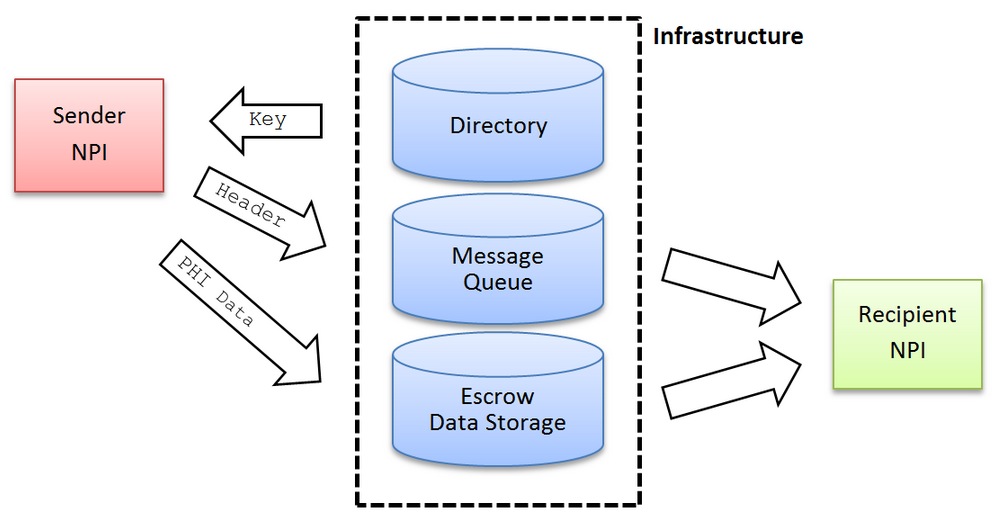
With the federally mandated NPI we already have a logical provider identifier. The infrastructure will retain a directory with all relevant information: Identifiers, type of provider, names, geo locations, specialties, contact preferences.

Screen Shot 2015-09-29 at 10.42.38 AM

All the NPIs in the directory will be assigned a secret fingerprint. This fingerprint will only be known to the owners and the infrastructure. It would be used (like a key) to verify the communication with the infrastructure.

To initiate a message the sender first requests a communication from the directory. The directory verifies the sender using the secret fingerprint and verifies if the contact preferences of the recipient are met. If so a message key will be generated, encrypted with the sender fingerprint and transmitted to the sender. The sender then decrypts the key with its fingerprint and encrypts the PHI data (attachments) of the message with the key, then uploads the data into the escrow storage. The sender then submits the message header with the key into the messages pool.

The message pool encrypts the message key with the recipient finger print. The recipient now picks up the message header and the key. It decrypts the message key with its fingerprint and downloads the data from the escrow. The PHI can now be decrypted on the recipient side.

Is it 2020 yet?

We should learn from our past. Historically as innovation was adopted, infrastructure was enabled and built for the benefit of the public and the economy: for example trains 1830s, telegraph 1850s, telephone 1880s, federal highways 1940s, and air traffic 1950s. Initial support from government was essential to the adoption and success of these innovations. Each facilitated the transmission of information and people for the benefit of the public and our economy. Even though deregulation and antitrust acts have followed in many of these examples – initial federal investment was essential for their adoption and success.

With healthcare costs rising and the increasing need of integrated and precision medicine to enhance treatments of patients, I believe the government should take any steps needed to enable a cohesive health provider communications network. 2020: The Health Data Highway.

Adrian Meyer is Director of Systems Development at ICISS at UNC.

Implementing Health Reform: PACE And EACH Acts Pass House; CMS Addresses Consumers Enrolled In Multiple Plans

Tim-ACA-slide

On September 28, 2015, the House of Representatives approved by voice vote without opposition two bills that would amend the Affordable Care Act (ACA). Given the rancor that surrounds anything related to the ACA in our sharply partisan—and largely nonfunctional—Congress, this is a remarkable occurrence worthy of note.

The first bill, HR 1624, the Protecting Affordable Coverage for Employees Act (PACE), would amend the provision of the ACA that would otherwise have provided that as of January 1, 2016, all employers with 100 or fewer employees would be regarded as small employers. Under current law in most states, employers with one to 50 employees are considered small employers while employers with 51 to 100 employees are considered large employers. The PACE Act would leave the one to 50 definition in place, although states would have the option of expanding the definition of small employer to cover employers with up to 100 employees. The bill had bipartisan support with 235 cosponsors.

This change is important. Small employers are treated very differently under the ACA than large insurers for purposes of insurance regulation. Insurers covering small employers must, for example, cover the ten essential health benefits and can only offer plans that fit into the actuarial value levels (platinum, gold, silver, and bronze) defined by the ACA. Small group plans participate in the risk adjustment program and are part of a single risk pool for setting premiums. Insurers may only consider age, geographic location, family composition, and tobacco use in setting rates for small groups. Large group plans are not bound by any of these requirements.

Most states have long defined a small group as consisting of 50 or fewer employees, which is how the term was defined by the Health Insurance Portability and Accountability Act which preceded the ACA. The drafters of the ACA had hoped that extending the definition to encompass groups as large as 100 would both reduce premiums for the under 50 groups by enlarging the risk pool to cover mid-size (51 to 100 employee) groups and extend the small group protections of the ACA to a larger population.

As 2016 neared, however, it has become increasingly clear that the change might do more harm than good. The apolitical American Academy of Actuaries, for example, predicted that increasing the size of small groups would likely raise premiums for the mid-size groups and might also raise premiums for small groups. It also raised the concern that healthy mid-size groups might self-insure, leaving primarily unhealthy groups in the small group insured market.

Many insurers write only in the large group market, therefore changing the definition of small group would likely result in many groups seeing their coverage cancelled. The definition change would also leave mid-size employers subject both to the employer mandate (which does not apply to employers with fewer than 50 employees) and the small group insurance requirements (which do not apply to employers with over 100 employees), a result that could appear unfair. The National Association of Insurance Commissioners, joined many business groups in opposing the transition and supporting the PACE legislation.

The CBO estimated that the PACE Act would reduce the deficit by $400 million over ten years because it would reduce premiums in the mid-size employer market, thus increasing taxable income of employees. It is thus one of the few potential amendments to the ACA that does not increase the deficit and require a “pay-for.” Other ACA amendments with bipartisan support have run into trouble when the question of how to pay for them was raised.

In March of 2014, the administration issued guidance allowing state regulators to permit employers in the 51 to 100 market to renew existing large group coverage for policy years beginning on or before October 1, 2016. Most states followed suit. But mid-size employers who did not have coverage as of January 1, 2016 and who purchased it thereafter (as they would have to do to avoid the employer mandate tax if one of their employees received marketplace coverage), would have to purchase coverage in the small group market. The PACE Act, if adopted by the Senate and signed by the President, would effectively make the transition policy permanent and extend its protection to mid-size employers purchasing coverage in the future.

There will be some tangles to work out if the PACE Act becomes law. A number of states have adopted the federal requirement into their own law and may make the transition as a matter of state law (as the PACE Act allows them to do). Insurers have presumably filed their 2016 rates assuming the current requirement would go into effect and likely cannot refile in most states this late in the year. But mid-size groups will presumably be able to find coverage in the large group market and the disruption in most states will probably be less than if the current law stayed in effect without the PACE Act amendment.

The Equitable Access To Care And Health Act Passes The House

HR 2061, the “Equitable Access to Care and Health Act” or the “EACH Act” also passed the House by a voice vote on September 28. It had bipartisan support from 176 sponsors. The EACH Act extends the ACA’s religious conscience exemption from the individual mandate to purchase health insurance to cover an individual who is a member “of a religious sect or division thereof . . ., who relies solely on a religious method of healing, and for whom the acceptance of medical health services would be inconsistent with the religious beliefs of the individual.” This language is commonly used to describe Christian Scientists, although it could conceivably cover other faith-healing denominations as well.

The ACA currently contains a religious conscience exemption, but it extends only to groups that reject all insurance, including Medicare and Social Security, like the Amish and some conservative Mennonite groups. Social legislation has traditionally, however, also made special provision for Christian Scientists and the failure of the ACA to do so can be regarded as an oversight. To obtain the exemption, applicants must attest that they have not received medical services during the prior year. Certain services, such as dental or vision services or vaccinations are not included. The bill also clarifies that it does not preempt state laws governing provision of medical services to children.

Parallel legislation to both the PACE and EACH act is pending in the Senate. The EACH Act in the Senate (S 352) has 30 bipartisan sponsors while the PACE Act (S 1099) has 45. If these bills can move in the Senate—without toxic amendments—we may finally see a path forward to improve rather than repeal the ACA, the direction favored by a majority of Americans.

Of course, if one is looking for evidence that political division over the ACA still reigns in Congress, one need look no further than the budget reconciliation act legislation shaping up in the House.  More on that in a future post.

CMS Mails Notices To Consumers Enrolled In MEC And Marketplace Plans

On September 28, 2015, CMS announced that it is beginning to mail notices to consumers whom it has identified as being enrolled in both minimum essential coverage (MEC) Medicaid or the Children’s Health Insurance Plan (CHIP) coverage and coverage through a marketplace plan with advance premium tax credit (APTC) or cost-sharing reduction payment (CSR) assistance. Consumers enrolled in both programs will be required to refund some or all APTC payments they receive for marketplace coverage while they are enrolled in MEC Medicaid or CHIP, and thus must promptly terminate marketplace coverage upon being enrolled in MEC Medicaid or CHIP.

Individuals are not eligible for APTC or CSR assistance if they are enrolled in MEC Medicaid or CHIP coverage. (Consumers can be enrolled in marketplace coverage while receiving some limited forms of Medicaid, such as family-planning only coverage.)

Nevertheless, some individuals are in fact enrolled in both marketplace and MEC Medicaid or CHIP coverage, usually because they applied for Medicaid or CHIP while already receiving marketplace coverage (for example, because their income dropped), and failed to terminate their marketplace coverage when they were determined eligible for Medicaid or CHIP. CMS has now begun conducting Periodic Data Matching (PDM) using the synchronous non-Employer Sponsored Coverage (ESC) MEC database to identify consumers identified in both forms of coverage. CMS also reviews data received from state Medicaid or CHIP agencies concerning dually enrolled individuals.

CMS will mail a notice to consumers whom it identifies as enrolled in both programs notifying them of potential tax liability and offering instructions as to how they can terminate their marketplace coverage either online or through the call center. Consumers who receive the notice but are in fact no longer enrolled in Medicaid or CHIP need take no action, but can contact their state Medicaid or CHIP agency to confirm that they are in fact no longer enrolled.

Consumers who receive the notice and who do not believe that they are enrolled in Medicaid or CHIP should contact their state agency to ensure that they are not in fact enrolled. Consumers who discover they are enrolled in Medicaid or CHIP but who are in fact no longer eligible for Medicaid or CHIP but are rather eligible for marketplace coverage should contact their state Medicaid or CHIP agencies for a redetermination of eligibility.

Consumers who wish to be enrolled in both marketplace and Medicaid coverage may do so, but will have to pay the full premium for marketplace coverage without APTC or CSR assistance. If an enrollee has both marketplace and Medicaid or CHIP coverage, Medicaid remains the payer of last resort under Medicaid coordination of benefits/third party liability rules.

The PDM process is limited to the federally facilitated marketplace (FFM), although state-based marketplaces are also supposed to have data matching programs. Ten FFM states were able fully to participate in the first round of the PDM, although they will be included in future rounds. Although this is the first time CMS is conducting data matching on this issue, it has consistently advised marketplace enrollees that they cannot be enrolled in Medicaid or CHIP and receive APTC or CSR assistance.

Information For Large Employers

Finally, the IRS posted at IRS.gov on September 17, 2015, an information center for applicable large employers. This center provides a single site with links to other IRS pages with information on large employer reporting requirements, the large employer responsibility requirement, and transitional relief from the employer responsibility requirement. The IRS has also released Publication 5165, a Guide for Electronically Filing Affordable Care Act (ACA) Information Returns, describing communication procedures, transmission formats, business rules, and validation procedures for the electronic filing of the ACA required reporting forms (IRS forms 1094-B, 1095-B, 1094-C, and 1095-C), which are first required to be filed by employers and insurers in 2016 for 2015.

Fetal Tissue Research: FAQ

medical research

Although fetal tissue research has made headlines in recent months, the controversy about it is nothing new. WebMD has the details

Experts Link Hormone-Disrupting Chemicals to Diabetes, Obesity

pesticide being sprayed onto plants

People who are trying to lose weight or manage diabetes should try to change their lifestyle not only to exercise or cut calories, but also to avoid hormone-disrupting chemicals that may be contributing to their condition, experts say.

Healthcare’s Perpetual War

Screen Shot 2015-09-28 at 1.49.03 PM

There are three visions of peace in the seemingly never ending, but really rather brief, Israeli-Palestinian perpetual crisis. One peace features two independent countries living in collaborative harmony on a piece of land approximately the size of New Jersey. Another peace yearns for a messianic Jewish state stretching from the blue Mediterranean shores to the Jordan River, and possibly beyond. The third and final peace is expected to materialize after the Zionist entity has been permanently erased from the face of this earth, or at least from the face of that New Jersey size holy piece of land.  Each definition is amenable to slight compromises in form, but not at all in substance.

There are three visions for the future of medicine in the seemingly insurmountable, but really rather minor, perpetual health care crisis in America. One future of medicine sees physicians unencumbered by useless administrative tasks, wielding sleek and useful technology tools, offering the best medical care to all patients who need and want attention. Another future is yearning for the revival of chickens and charity as bona fide methods of payment for whatever medical care the free market wishes to bestow on the less fortunate. The third and final future is one devoid of most middling and often faulty doctors, where the health of the nation is enforced by constant computerized surveillance with fully automated preemptive interventions.  Each definition is amenable to slight compromises in form, but not at all in substance.
Years ago I used to walk the streets of East Jerusalem, buy dates in the open air markets of Jericho, and search for the perfect plate of hummus in Ramallah. Everywhere I went people wanted the same things I did. They wanted the rain to stop, or the hams in to break. They wanted their coffee hot and strong and their bread soft and warm. I said shalom and they said salaam and we all meant the same thing, because ironically people in the Middle East always wish peace upon each other, and people like us, who buy and sell cheap jewelry or dates or hummus, actually mean it.

Census Estimates Show Progress Toward ACA Coverage Goals — But There Is More To Be Done

Blog_Berk

The Census Bureau released a report last week that showed a drop in uninsurance between 2013 and 2014 of 2.8 percentage points — which translates into 8.5 million fewer uninsured people based on information from the American Community Survey (ACS). The same release also showed a comparable decline in the full-year uninsured as measured by the Current Population Survey (CPS).

These new estimates confirm findings that have been reported in other private and public surveys. These other surveys focused on non-elderly adults and showed larger decreases than the Census, because the Census release focused on the entire population. Since the coverage provisions of the Affordable Care Act (ACA) are targeted at lowering uninsurance among non-elderly adults, the Census approach results in a smaller percentage point change. The key point, however, is that a substantial reduction in uninsurance has been confirmed by these two large, highly respected federal surveys.

Underlying Changes In Private And Public Coverage

Much of the decline is likely due to the implementation of key provisions of the ACA, though the improving economy could also have contributed to some degree. Data from the ACS showed only a slight decline between 2010 and 2013 when the economy was recovering, followed by a sharp decline between 2013 and 2014 when the main coverage provisions of the Affordable Care Act took effect. Moreover, the coverage increases that contributed to the reduction in the uninsured were highly consistent with the coverage provisions of the ACA.

According the CPS, the percent of the population with Medicaid coverage at some point over the course of the year increased from 17.5 percent in 2013 to 19.5 percent in 2014. This is consistent with the ACA’s Medicaid expansion, although this increase would have been greater had all states expanded Medicaid coverage. There was also an increase in nongroup coverage as a source of insurance, growing from 11.4 percent of the population in 2013 to 14.6 percent in 2014. This is consistent with the provision of income-based tax credits to purchase nongroup coverage through the new health insurance marketplaces. For those under 400 percent of the federal poverty level (FPL), these tax credits are available regardless of whether or not states adopted their own marketplaces.

Insurance Changes Across Demographic And Socioeconomic Groups

Further evidence from the CPS in the Census report indicates that the ACA is indeed contributing to the observed coverage gains, because the specific population subgroups targeted by the ACA provisions experienced particularly large reductions in uninsurance rates. For example, low-income individuals had substantial percentage point drops in the rate of uninsurance. Those below 100 percent FPL saw a drop from 23.5 percent to 19.3 percent, while those between 100 and 199 percent FPL saw a decline from 20.4 percent to 15.1 percent. These are the income ranges targeted by either the Medicaid expansion or by the most generous marketplace tax credits.

Age groups with the highest uninsurance rates historically, those between 19-24 and 25-34, and minorities, particularly blacks and Hispanics, had larger reductions in uninsurance than other subgroups. Similarly, individuals with less than a high school education or who just graduated from high school had the highest uninsured rates in 2013 and 2014, but had larger reductions between years than those who were more highly educated. Finally, part-time workers and non-workers had the highest uninsurance rates in 2013 and saw larger declines in 2014 than full-time workers. This suggests that the coverage provisions of the ACA are serving to narrow longstanding gaps in coverage.

At the same time, the rate of employer-sponsored insurance (ESI) was relatively constant. Some predicted that ESI rates would fall as Medicaid coverage and income-related subsidies became available. In previous work with the Health Reform Monitoring Survey (HRMS), we showed no change in ESI rates. The recent Census report confirms that at least through 2014, ESI rates were holding steady.

State Level Trends

Finally, state-level estimates for non-elderly adults from the ACS also reflect the likely effects of ACA policy changes related to state decisions regarding Medicaid expansion. ACS data confirm the general pattern previously reported by the Urban Institute using data from the HRMS.

As shown in Table 1, the states that expanded Medicaid by January 1, 2014 had lower uninsured rates on average among adults aged 18-64 in 2013 and also experienced larger drops in the uninsured by 2014. These states saw their average uninsured rate fall from 18.5 percent in 2013 to 13.7 percent in 2014, a decline of 4.8 percentage points (the estimates in Table 1 were not included in the Census release but were derived from the American FactFinder). Several of these states had reductions of more than 6.0 percentage points in the uninsured rate among non-elderly adults and Oregon, Kentucky, Washington, and West Virginia had reductions of 7.0 percentage points or more.

In contrast, states that did not expand Medicaid had an average uninsured rate for those ages 18-64 of 22.2 percent in 2013, which fell to 19.0 percent in 2014, a decline of 3.2 percentage points. It is important to note that the non-expansion states still had significant reductions in their uninsured rates. This may be due to the fact that uninsured rates were higher to begin with and that there was heavy enrollment in marketplaces or in Medicaid among those eligible under pre-ACA rules (the woodwork effect) in many of the non-expansion states; of note, the uninsured rate among non-elderly adults in Florida declined by 5 percentage points.

Survey Issues

All in all, the new Census data confirm results reported earlier by other surveys, which is extremely important. The Census surveys have important strengths relative to these other surveys, including a larger sample than the National Health Interview Survey and higher response rates than the private surveys by Gallup and the Urban Institute. They also provide much more reliable state level information than is available from other sources.

There is one methodological issue that is concerning. The Census reports an uninsured rate at the time of the survey from the ACS of 11.7 percent for 2014 and an uninsured rate for the entire calendar year from the CPS of 10.4 percent.

These rates are closer together than one would expect given evidence from prior research. Despite changes in the CPS questionnaire, the CPS may still be overstating the full-year uninsurance rate. In addition, it is not clear why the Census release provides so few point-in-time coverage estimates based on the CPS — with the revamped instrument, one would expect those estimates to be very robust and informative about the types of coverage people have at the time of the survey. Moreover, they provide the most timely look at coverage available from the Census — namely, conveying coverage status just six months ago in early 2015, which would have reflected coverage gains through the second open enrollment period.

What’s Next?

Even with this limitation, the results reported by the Census in this release provide compelling evidence that uninsurance is declining for the groups targeted by the ACA. At the same time, an uninsured rate of 10.4 percent whether it is point-in-time or for an entire calendar year is still relatively high and above what was originally projected for the first year of the ACA by the Congressional Budget Office.

While these results are encouraging, they show how much more there is to be done. The uninsured rate should fall further as marketplaces mature, the tax penalty for not having coverage increases, and as more states expand Medicaid. Policies that increase premium and cost sharing subsidies, provide stronger incentives for states to expand Medicaid, and provide additional support for the administration of the program at both the federal and state levels could help assure continued progress.

Table 1: Non-Elderly Adult (18-64) Population Without Health Insurance Coverage By State: 2013 And 2014

Copy-of-ACS-table-with-uninsured-rates-for-Non-Elderly-adults-2013-and-2014

Source: U.S. Census Bureau, 2013 and 2014 American Community Survey 1-year estimates from Table S2701 in American Fact Finder. September 2015. 

Notes: ¹Medicaid expansion status as of January 2014

*Difference between 2013 and 2014 is significant at the .10 level 

^The change in uninsurance rate between 2013 and 2014 in expansion states is significantly different than the change in non-expansion states at the .10 level .

Authors’ Note

The authors appreciate the assistance of Patricia Solleveld, Timothy Waidmann, Michael Karpman, Laura Skopec, and Erik Wengle.

Sweetened Drinks May Damage Heart, Review Finds

Petition by leading consumer advocate group and

Added sugars raise risk of heart troubles, stroke, experts say

Health 2.0: Exclusive Interview with Susannah Fox, CTO of HHS

Susannah Fox, CTO of HHS, shares how she is fostering patient empowerment and engagement through technology. Matthew Holt, Co-Chairman of Health 2.0, had the opportunity to personally chat with Susannah and learn more about the democratization of healthcare!

Don’t miss Susannah Fox at the 9th Annual Health 2.0 Fall Conference. Purchase your tickets here!

Matthew Holt: Matthew Holt here, delighted to be on with a really wonderful amazing person in healthcare who is not only my friend but also the CTO of HHS, Susannah Fox.  Susannah, thanks so much for joining us.

Susannah Fox: I am thrilled to be talking with you.

Matthew Holt: Well, so those of you who don’t know — Susannah originally was a journalist at U.S. News and World Report and spent many, many years at Pew Research, and is basically leading the survey research understanding the patient experience — probably in healthcare as a whole but studying the patient experience with the use of technology.  She happens to be the first proper keynote speaker we ever had at a Health 2.0 conference back in 2008, attended Health 2.0 in many different places with us, and has been a great friend and colleague.

And then she more recently spent about a year at the Robert Wood Johnson Foundation as an Entrepreneur in Residence.  And amazingly enough, RWJ and HHS today did a player swap in which Bryan Sivak who was the CTO of HHS went to Robert Wood Johnson and Susannah went to HHS as CTO.  So, Susannah, I hope I got that history about right.

Susannah Fox: Yes indeed, yes.  What was fun about Bryan and I is that when I was being recruited for the CTO role, I didn’t tell anyone at RWJ, and then when I left they had been quietly thinking about Bryan for the role of Entrepreneur in residence anyway.

Matthew Holt: Who gets the player to be named later?  And who is the player to be named later?  All right, so let’s talk a bit.  I want to capture a couple of things that we’re going to talk about.  Obviously, you’re going to be at this year’s Health 2.0.  We’re going to have a little chat and then you’re going to be sitting on our panel mostly about the patient experience and the impact of technology on patient experience and patient outcome, something like that, that’s very close to your heart.

So why don’t we start off a bit on just a little bit about the work you’re doing at RWJ because some people don’t know exactly what you’re doing there and you’re doing some really interesting, deep research there.  So why don’t you say a little bit about your brief experience there?

Susannah Fox: At the Robert Wood Johnson Foundation, I was the second entrepreneur in residence.  The first one was Thomas Goetz.  It’s a really interesting role because they want to bring in an outside perspective to the foundation.  What I decided to look at was how to encourage the foundation to open up more doors and windows to the outside world.  How might we listen more to the communities that we want to serve and therefore serve them better?

The other initiative that I was working on while I was there was recognizing the importance and really the gift of failure that when there is a grant that’s made that doesn’t go very well, that can be as much of a positive learning in the end as a grant that goes really well.

Entrepreneurs know this that if you try out a new project or a new product and customers say, “No, I won’t use that,” that’s actually a gift because you know what not to do.  And so, those are the sorts of principles that I was talking about with the foundation.

Matthew Holt: Sounds good.  Speaking as a “forced entrepreneur,” I’m not sure I like that whole “failure is a gift notion.”  You come to the gift that you pay for, not the other way around.

Susannah Fox: Well, that’s with trying small things and trying little experiments all the time so that you don’t get caught investing a huge amount of money on something that’s not yet tested.

Matthew Holt: Yeah, I think that’s probably very true across foundations as a whole.  Many of them have been guilty enough for any malfeasance of starting long, long initiatives that in the end didn’t pay off much and not doing sort of that fail-fast experimentation at the start that you’re trying to encourage now and you’re actually trying to encourage at HHS.  That’s great.  Can you say a bit more about your patient experience?  You were doing at little bit of it at RWJ as well.

Susannah Fox: Sure.  What I have been doing for the last 15 years, I started doing it while at the Pew Research Center and then continued it with the Robert Wood Johnson Foundation, was always staying as close as possible to the frontlines of healthcare. Tim O’Reilly has this great phrase that “If you want to see where the future is heading with anything but especially with technology, you need to follow the alpha geeks, the hackers.”  In healthcare, the alpha geeks are people living with rare disease and life-changing diagnoses.

And so, what I tried to do is spend time in communities either in real life going to conferences or online in virtual communities, spending time with people who are living with rare conditions because they’re going to push the envelope in every direction in healthcare and in technology.  It’s really by following them that I get my best ideas and see where things are headed.  And that’s also what I’m bringing into HHS, the sense that we need to stay close to the customer, close to the end user.

Matthew Holt: Wonderful.  So now you’re at HHS, let’s talk a bit about that.  First off, you’re the chief technology officer.  But strictly speaking, although you’re following someone who is a deepwater geek in Bryan Sivak who is a technologist who ran technology companies, you’re a sort of journalist/researcher with a deep interest in technology.  That probably implies something about what HHS is looking for in terms of its technology interaction.

We started with Todd Park who was all about opening up data sources and Bryan Sivak who was about — and you can correct me if I’m wrong — building tools and relationships to use that data on top of those data sources and obviously following on Todd’s work.  That work I’m sure is continuing.  I know I’ve seen some great stuff at HHS in the technologies offices and you can talk a bit about who’s doing what there.  And great foundations have been laid for that.  And obviously, there is Health 2.0 and Health Data Initiative and a bunch of other areas and a bunch of other people as well obviously working on that and that’s continuing.  But give me a sense about your special interests and your special flavors that you’re going to bring to this.

Susannah Fox: Well, I’ve always been interested in understanding how people are engaging with technology and engaging with healthcare.  That turned out to be a keyword also for the people who were interviewing me for this job.  When I kept saying, “Now, you understand that I’m more of an anthropologist than a technologist?” they would say, “Yes, yes.”  And I would say, “Okay, I’m really interested and even to the point of obsessed with patient empowerment and patient engagement.”  And they said, “Yes, exactly, thank you,” because they understand that technology these days is not necessarily about the code, it’s about culture.

In bringing me in as the chief technology officer now, they’re acknowledging that what we really need to do is have a holistic view of how technology is affecting American healthcare. What’s great is that this really is a continuation of the work that Todd and Bryan did because part of being the chief technology officer, it’s really the chief innovation officer.  Bryan added the title also of “Entrepreneur in Residence” at HHS.  It’s bringing that sensibility of an outsider view into the secretary’s office so that our role here and the Idea Lab and as CTO is to look across the landscape and look a little bit into the future and help people here at HHS to anticipate the future better.  The best way to do that is to, again, follow the alpha geeks to make sure that you have the perspective of your customers which again is a core principle of being a great entrepreneur, to always be sure that you’re serving your customer.

Matthew Holt: Can you say a little bit about the infrastructure you already have there and the kinds of projects that you’re actually working on now and what we can expect to see?

Susannah Fox: Yeah. We divide the work of the Idea Lab into three areas.  The first is promoting internal innovation.  That is where we teach the entrepreneurial principles and design thinking to people who work here at HHS and across all the 11 operating divisions.  We do that in three ways.  We have an Ignite Accelerator program, that’s a three-month program that’s pretty competitive to get in.  Once people get in, they bring in a problem to be solved.

Matthew Holt: Is that internal HHS stuff or is that anybody?

Susannah Fox: Yeah. People apply who work at the CDC or the FDA.

Matthew Holt: Somewhere across the organization.

Susannah Fox: Somewhere all across the operating divisions.  They then come in for individual mentoring and training to try and solve a problem that they’ve encountered in their work.  What’s wonderful is that we also bring in advisors from the University of Maryland.  We give these folks who are working for the federal government the opportunity to think like an entrepreneur and to learn some of those skills.  We give them a little bit of money.  But the most important thing is that we give them some air cover so that they get permission from their supervisor to work on something new and to essentially try and create a minimum viable product that they then put in front of their customers.

It’s very accelerated. Our demo day is actually going to be this Thursday where it’s kind of the graduating class of the current crop.  One of the projects has been so successful that it actually has already launched because they created something that their supervisor and colleagues were so in favor of that they said, “We’re not going to wait for your graduation from this program.  This is fantastic, we’re doing this.”

The other thing that we do is we have a Ventures Fund where we seed projects that might not get noticed otherwise but we have a little fund that we try our hand in a little venture capital within HHS.  We also hold award ceremonies, the Innovates Awards.

The second area that we look at is leveraging external innovation.  And this is wonderful.  We bring in external entrepreneurs and innovators into the federal government for short sprints, either one or two years, again, to tackle a specific problem.  If you’ve heard about the Presidential Innovation Fellows program at the White House, that actually is based on our entrepreneur in residence program.  It’s something that Todd started here and then brought with him when he became the White House CTO.  What that does is it first of all brings in outside skills that maybe people within government don’t have, and there are some really fantastic examples which I can talk about.  But what we also really want to do, part of the ulterior motive is to infect people with this idea that innovation can happen in the federal government.

And so, half of our EIRs and IIRs have been asked to stay on and many of them do.  That’s a way for us to build the talent within the federal government to attract people who never really thought they would do federal service, like me.  They bring them in and show what great impact you can have working here.

The third area that the Idea Lab looks at is building collaborative communities.  With that, the Health Data Initiative is the most well-established of those programs.  We’ve really created a community around open health data.  Not only a community, but a marketplace where there is so much interesting development going on around the data that the government releases about healthcare.

We also have something called “Buyers Club” which is about something that I really honestly didn’t know anything about before I started here which is government acquisition.  But we really, really need to modernize it.

Matthew Holt: “Buyers Club,” you said?

Susannah Fox: “Buyers Club,” isn’t that a great name?

Matthew Holt: It’s like the Dallas Buyers Club, yeah, illicit distribution of medication in HHS?  No, you’d better deny that part.

Susannah Fox: One of the themes across all of these is that we need to have interdisciplinary teams.  That’s something that we promote across all the areas that we work on.  And it’s true for Buyers Club as well.  It’s something that you need to bring in, for example, a contracting officer as soon as you have an idea for a new government program because that person can help you design a contract that, for example, is agile instead of waterfall design understanding that anything having to do with digital or software these days, you need to have a different kind of acquisition of that kind of service. Now, what I’m really interested in is that all of these programs point towards democratizing and opening access to information data and tools.

And you’ll notice, Matthew, but the thing that I’m currently obsessed with is the “Maker Movement.”  Do you know about the Maker Movement?

Matthew Holt: Of course, yeah.  In fact, years ago, Health 2.0 had a booth at the Maker Faire.

Susannah Fox: Really?

Matthew Holt: It was really funny.  That Health 2.0 actually was like a whole pavilion, they (00:15:25) worked on this together.  It was on a county fair ground, and because they had to have the same vendors as any other fair in the county fair ground, immediately outside the Health 2.0 sign was the funnel cake, right there.

For those of you listening who don’t know, the Maker Movement is the modern-day tinkerers, people who are building things with their hands and technology and the physical embodiments of technology.  So then you’ve got the got the backyard building rockets and building robots and building stuff.  There are applications all over the place.  It’s really quite fascinating.

Susannah Fox: Yeah.  And it’s our answer to sort of the homebrew computing club.  What’s built in garages is now coming out for show and tell at Maker Fairs and other places.  I started picking up signals about this about five years ago in my fieldwork where I would be talking to people with diabetes or rare disease.  I would be asking them about access to information, access to data, and access to crowdsourcing techniques.  And they would say, “Yes, yes, I can tell you about that.  But let me show you what I made.  Let me show you this device that I had to create for my kid.”  Or, “I’m a caregiver for someone and this is the way that I had to create something to prevent, for example, my loved one who has dementia from flushing her adult diaper down the toilet.”

You might remember that I talked about this onstage during the unmentionables panel one year.  This is something that I’m very, very interested in.  I think that the Maker Movement will have as significant an effect on health and healthcare as we’ve seen for data particularly as the costs of manufacturing go down and 3D printers and other technology start to become very, very common.  Just like cloud computing with the accelerants that got poured on the fire for big data, the lowering cost of manufacturing is the accelerant that’s going to get poured on the fire of what I’m calling the “inventing health” or “health maker ecosystem.”

Matthew Holt: That’s very cool.  Actually, Indu and I were talking about this, how to describe what I was starting to call — I call it the democratization of diagnosis, it’s one thing, and then the sort of lowering and up streaming of treatment.  And then you’re talking now about all the other pieces that go around that including, like you said, flushing the adult diaper down the toilet, what kind of tools can prevent that and what can be built openly?  And this is happening obviously not just in health but in energy and in manufacturing, across the board.  But it’s fascinating.

Susannah Fox: Yeah, absolutely.  And in joining the federal government, there actually is already an interest group of people who are interested in the Maker Movement.  There are people at, actually, FDA and NIH as well as USAID and the VA.  There are all kinds of people who are already interested in this in all sorts of sectors of healthcare.  So drawing that together and understanding what we in government can do to understand this ecosystem and to, frankly, get out of the way sometimes.  That sometimes is the best role for government.  To, again, open up doors and windows so that people can see in and so that we can learn from people who are really on the front lines of healthcare.

Matthew Holt: Fabulous.  Okay.  Well, let me say thank you very much to my guest, Susannah Fox, CTO of HHS.  We’re looking forward to seeing Susannah onstage.  She’s on a panel, as she ought to be, on the patient experience, the new patient experience and outcomes which is coming on Monday afternoon.  We are on just after Chelsea Clinton.  Well, after Chelsea Clinton and Indu herself which is very, very impressive.

And there is going to be a lot of great technology on that panel showing a lot of the things that may impact patient experience.  We’ll have a patient, Kym Martin who you know well, who has had more bouts of cancer than most people can imagine, and Sachin Jain who is now the CMIO down at CareMore.  But it’s going to be a great panel and I’m looking forward to chatting with you there and seeing you then.  So, Susan, I thank you so much for your time today.

Susannah Fox: Thank you.

Deepa Mistry is a Marketing & Operations associate at Health 2.0

Health Policy Brief: Navigators And Assisters In The Third Open Enrollment Period

Recurring Topic Image - Health Policy Brief (640 x 360 at 72 PPI)

A new policy brief from Health Affairs and the Robert Wood Johnson Foundation (RWJF) looks at the role played by navigators and in-person assisters as the third open enrollment period for the insurance Marketplaces begins.

A 2014 Kaiser Family Foundation survey found that during the first open enrollment period, navigators, in-person assisters (also known as IPAs), and other assisters helped more than 10.6 million people apply for health insurance and obtain financial assistance. A provision of the Affordable Care Act (ACA) made funding for IPAs (but not for navigators) available to states that set up their own exchanges but less so for those states relying on the federal Marketplace.

This brief outlines the current responsibilities of navigators and assisters, and how these roles have evolved and may change.

What’s the Law?

As the brief explains, the ACA lists the duties of navigators and the training requirements instituted by the Department of Health and Human Services (HHS). The brief notes the differences between states relying on the federal Marketplace and state-based exchanges, adding that the role of IPAs was not part of the ACA legislation but established by HHS under its regulatory authority.

What’s the Debate?

Since many navigators and IPAs were funded through one-year grants, their continuity has sometimes been precarious. As the brief explains, some states turned to insurance agents and brokers, many of whom did not embrace the ACA, to fill the void. The brief provides examples of ways different states used brokers to fill consumer assistance needs — and also points out that although brokers may continue to play an integral role in enrollment going forward, they may have less experience with assisting some hard-to-reach populations that the Marketplaces are trying to enroll.

What’s Next?

As the third open enrollment period gets underway, the brief observes that leveraging relationships with brokers can help fill gaps in consumer assistance and leave time for navigators to focus on tough cases and hard-to-reach populations. HHS recently announced $67 million in grant funding for navigators, with the possibility of three-year grants, bringing peace of mind to navigator entities that worry about the sustainability of their work.

About Health Policy Briefs

Health Policy Briefs are aimed at policy makers, congressional staffers, and others needing short, jargon-free explanations of health policy basics. The briefs, which are reviewed by experts in the field, include competing arguments on policy proposals and the relevant research supporting each perspective.

Sign Up For Health Policy Briefs

Sign up for an email alert about upcoming briefs. The briefs are also available from the RWJF’s website.

Please feel free to forward the briefs to any of your colleagues who are tracking health issues. And after you’ve taken a look, we welcome your feedback.

More Evidence Daily Aspirin May Fight Colon Cancer, Other Gastro Tumors

But risk of macular degeneration doesn't outweigh

4-year study found survival doubled for gastrointestinal cancer patients who took low-dose pill each day

The HDE Project coming to Health 2.0’s annual Fall Conference!

Screen Shot 2015-09-28 at 3.34.22 PM

The Health Data Exploration project, sponsored by the Robert Wood Johnson Foundation, is building a network of academic, public sector, and corporate partners working together to catalyze the use of personal health data to conduct research that benefits the public good.

Individuals are tracking a variety of health-related data via a growing number of wearable devices and smartphone apps. More and more data relevant to health are also being captured passively as people communicate with one another on social networks, shop, work, or do any number of activities that leave “digital footprints.” Self-tracking data can provide better measures of everyday behavior and lifestyle and can fill in gaps in more traditional clinical or public health data collection, giving us a more complete picture of health.

The HDE team works on a variety of projects that demonstrate the value of using personal data in research and create reusable templates, policies, and infrastructures for using new forms of data. Core research projects address cross-cutting issues relating to personal health data including exploring barriers to data sharing (including privacy and consent issues) and addressing methodological challenges that arise from these new forms of data.

MACRA: New Opportunities For Medicare Providers Through Innovative Payment Systems

Blog_OShea

Today, almost 60 million Americans are covered by Medicare — and 10,000 become eligible for Medicare every day.

For many years, Medicare was primarily a pure fee-for-service (FFS) payment system that paid health care providers based on the volume of services they delivered, not the value of those services. Over time, this contributed to increased costs with little improvement in the quality of care.

However, that system is changing as we work to improve our nation’s health care delivery system to ensure patients and their families receive the best care possible. And, we want to hear from you. Today, the Centers for Medicare & Medicaid Services (CMS) released a Request for Information (RFI) to seek public comment related to new provisions in the Medicare Access and CHIP Reauthorization Act of 2015 (MACRA): Merit-based Incentive Payment System (MIPS), Alternative Payment Models (APMs), and a physician-focused payment model (PFPMs).

Driven by the Affordable Care Act, CMS has taken substantial steps toward this better, smarter, and healthier system through quality improvement programs, promotion of electronic health record use, Accountable Care Organizations (ACOs), Patient Centered Medical Homes, bundled payment models, and other Alternative Payment Models (APMs) developed at CMS.

Driving CMS further along the path to value, in January 2015, Secretary Burwell set goals for 30 percent of traditional Medicare payments to be tied to APMs, such as bundled payments, ACOs, or medical homes, by the end of 2016, and 50 percent of such payments to be tied to these models by the end of 2018.

The Department of Health and Human Services (HHS) has already made significant progress in reaching these goals. In 2011, no Medicare payments were made through APMs; by 2014, approximately 20 percent of payments were made through these APM arrangements. And, HHS continues to catalyze stakeholders across the health care spectrum to join in the path to value. In March 2015, HHS launched the Health Care Payment Learning and Action Network to bring together stakeholders in the public and private sector to accelerate adoption of value-based payments and APMs.

The MACRA: A New Opportunity

On April 14, 2015, a large bipartisan majority in Congress passed the Medicare Access and CHIP Reauthorization Act of 2015 (MACRA). President Obama signed the MACRA into law on April 16, 2015. The MACRA permanently repeals the flawed Sustainable Growth Rate formula for determining Medicare payments for clinicians’ services, establishes a new framework for rewarding clinicians for value over volume, and streamlines other existing quality reporting programs into one new system.

The MACRA was passed with bi-partisan support and will help accelerate paying for and rewarding value. Implementation of the MACRA is a major opportunity to put a broad range of health care providers on the path to value through the new Merit-Based Incentive Payment System (MIPS) and incentive payments for participation in certain Alternative Payment Models (APMs).

Path #1: MIPS

The MACRA sunsets the payment adjustments associated with the Physician Quality Reporting System, the Value-based Payment Modifier, and the Medicare Electronic Health Record (EHR) incentive program for Eligible Professionals. The MIPS combines those efforts into a single consolidated program with four weighted performance categories upon which eligible professionals (EPs) will be assessed: Quality; Resource Use; Clinical Practice Improvement Activities; and Meaningful Use of Certified EHR Technology.

MIPS requires the Secretary to develop and provide clinicians with a Composite Performance Score that incorporates MIPS EP performance on each of these categories. Based on this Composite Performance Score, EPs may receive an upward, downward, or no payment adjustment. MIPS offers an opportunity for EPs to achieve significant financial incentives for providing health care that advances the goals of a better, smarter, and healthier system.

Path #2: APMs

The MACRA also provides incentives for participation in certain APMs. “Qualifying APM participants” will not be subject to MIPS adjustments and will receive a lump sum incentive payment equal to 5 percent of the prior year’s estimated aggregate expenditures under the fee schedule. The 5 percent incentive payment is available from 2019 to 2024, but beginning in 2026, the fee schedule growth rate will be higher for qualifying APM participants than for other practitioners.

The MACRA also encourages expansion of the APM options available to physicians, especially specialists, through physician focused payment models (PFPMs). The law requires the establishment of a Technical Advisory Committee that will assess PFPM proposals submitted by stakeholders and make recommendations to the Secretary about which models to consider testing. This is a valuable opportunity for stakeholders to participate in delivery system reform by developing and submitting their ideas for APMs.

Request For Information

We encourage you to read the RFI and submit comments to CMS within the next 30 days. Your input is very important to us.

As we implement this historic legislation and continue to advance along the path to value in health care, we hope stakeholders will take this opportunity to provide input through the RFI. These new programs afford providers the opportunity to be rewarded for providing high quality care at lower costs, and our goal is to help providers be successful while reducing administrative burden. Together, we can create a health care system that delivers better care and healthier people and spends health care dollars more wisely.

Genes Help Set Menopause Timing: Study

Study looked at CRTC1 gene, already associated

Findings might one day lead to fertility predictions, experts say

ICD-10 and the Apocalypse

Screen Shot 2015-09-28 at 9.42.44 AMOctober first is nearly upon us.  For many of us, this date has little significance beyond the promise of cooler weather, lovely autumn colors, and the invasion of neighborhoods with giant inflatable Halloween decorations.  While these decorations are fascinating to me, they do cause me to ponder the enormous gulf  between my taste and that of my neighbors.  I am not certain if this is meant to scare off potential alien invaders or simply to make them think we are not worth bothering with.

October 1, however, is a huge day to the medical community.  It is a day that will live in infamy.  It is the object of dread, of diaphoresis, of doom.  October 1 is ICD-10 day.  This view was further bolstered when I went to the CMS (Government Medicare) website, there was actually a doomsday countdown timer at the top of the page. Just looking at this makes me anxious.

For those still unaware, ICD-10 is the 10th iteration of the coding taxonomy used for diagnosis in our lovely health care system.  This system replaces ICD-9, which one would expect from a numerological standpoint (although the folks at Microsoft jumped from Windows 8 to Windows 10, so anything is possible).  This change should be cause for great celebration, as  ICD-9 was miserably inconsistent and idiosyncratic, having no codes describing weakness of the arms, while having several for being in a horse-drawn vehicle that was struck by a streetcar.  Really.

But, as Abe Lincoln may have said, better the devil you know than the one you don’t.  We all got used to the stupidity of ICD-9, and, like the crazy neighbor who puts huge inflatables of the Santa Maria in their yard on Columbus day, we learned to tolerate its eccentricities.  It’s better than having an axe murderer or hospital administrator in that house.  Unfortunately, the folks over at ICD Inc. got overly zealous in their desire for completeness, increasing the number of codes from the 17,000 in ICD-9 to over 90,000 in ICD-10.  It’s as if that neighbor not only added the Nina and Pinta to their lawn, but also inflatable natives infected with smallpox along with a mural depicting the skyline of Columbus Ohio.  It seems a bit over the top.

Anyone paying attention to this subject knows of the ludicrous codes now available to the medical community (being bit by a duck while wearing a thong, being bit by a duck that is wearing a thong, being bit in the thong by a duck, being crushed by a giant inflatable while eating kale, etc), so I won’t go into those now.  These give health wonks hours of entertainment, for which we are all grateful.  But there is a much bigger, more serious set of problems brought about by the onslaught on the medical community by the ICD hoards.

Before I go into this, however, let me state that, because I no longer live in the insurance world (doing Direct Primary Care), I do not bear the brunt of this apocalypse.  Yes, we are inconvenienced by the need to submit ICD-10 codes for consults, labs, and procedures, but that is about the extent of it.  I was tempted to get snarky here and lord this fact under my suffering colleagues, but thought better of it.  While this may be a boon to the growth of alternative practice models like DPC, gloating over it seems cruel.  Having lived in the land of insurance and codes for 18 years, the prospect of converting over to ICD-10 even now gives me cold sweats.

There are two main problems with this conversion from 9 to 10.  The first problem is that, as I’ve written before, codes are the product produced by health care businesses.  Health care providers (doctors, hospitals, and the rest) are paid for producing problem (ICD) codes and matching them with procedure (CPT and E/M) codes.  This is the product they sell to their true customer: the third party payors.  Submission of the wrong codes has one main result: no payment.  Codes are the lifeblood that carry the money to medical providers, and so changing those codes threatens the financial viability of medical businesses, large and small.  Get this conversion wrong, and you don’t make enough money to stay in business.

Now, because there has been enough time and the with ubiquity of EMR systems centered on billing, the ironic heroes in this may be the EMR vendors.  This should minimize the overall damage to the financial survival of medical businesses.  Despite this fact, the conversion of codes strikes at the very heart of our health care business model.

The bigger issue here is the fact that, while they are the ones saddled with the expense of conversion and the ones facing the financial risk of not doing so, there is no obvious advantage to the doctors themselves to be making this transition.  ICD coding is a billing nomenclature that does not give any apparent benefit to patient care. Codes don’t help us make diagnoses, nor do they improve doctor-patient relations. In fact, it’s very likely that this transition will lessen the ever waning focus on the patient while providers are obsessing on getting the code that will get them paid.  The only positive most medical practitioners will see out of this conversion is getting rid of ICD-9.

Perhaps, like the 30 foot Santa riding a motorcycle which exploded in my neighbor’s lawn last December, my fears are overinflated.  The reality is that October 1 will come and go without the world caving in on the medical community.  But my fear is that this is one more way our system is alienating and frustrating its workforce.  This is, in my view, the more serious problem that will soon overtake all others.  It is possible to still love practicing medicine, even in the screwed up system we have.  But the number of doctors, nurses, and other providers who are reaching their limit is growing quickly, as witnessed by the number of phone calls and emails I am getting from doctors looking for an alternative.

Perhaps that’s a good thing, as the misery created by ICD-10 may drive the system toward a better model.  But I don’t imagine the ICD corporation and its minions are pushing this on us with this intent.  Someone somewhere thinks this makes sense.

Just like my neighbor who thought it made sense put a giant inflatable pregnant woman in front of their house for Labor Day.

Realigning Medicare Part D Incentives: A New Model For Medication Therapy Management

Pills

The Centers for Medicare and Medicaid Services (CMS) Center for Medicare and Medicaid Innovation (CMMI) is announcing a new demonstration model today to test changes to the Medicare Part D program. These changes are designed to better align the standalone prescription drug plan (“PDP”) sponsor and government financial interests, while also creating incentives for more robust investment and innovation in targeting medication therapy interventions.

The goal of the Part D Enhanced Medication Therapy Management (“MTM”) Model is to deliver greater value and better health outcomes for Medicare and its Part D beneficiaries. This demonstration is consistent with the Department of Health and Human Services’ goal of tying 30 percent of Medicare payments to alternative payment models by the end of 2016 and 50 percent by the end of 2018. Moreover, this demonstration represents an opportunity for CMS, plans, pharmacists, and other providers to unlock the potential of MTM for improving adherence and safety and delivering higher-value prescription drug benefits to Medicare Part D beneficiaries.

Medication Therapy Management Program In Medicare Part D Today

The Medicare Prescription Drug, Improvement, and Modernization Act of 2003 (the “MMA”) amended the Social Security Act to provide a voluntary prescription drug coverage program for Medicare beneficiaries. Since January of 2006, subsidized prescription drug coverage has been available to Part D eligible Medicare beneficiaries through Medicare Advantage (“MA-PD”) or through a stand-alone PDP under Part D. As of August of 2015, nearly 40 million Medicare beneficiaries were enrolled in a Medicare-sponsored plan that provides prescription drug coverage, with approximately 24 million Medicare beneficiaries accessing their prescription drugs through a stand-alone PDP.

Providing Medicare beneficiaries access to affordable prescription drugs has been recognized as a needed improvement to the Medicare program. Prescription drugs are often the first line of therapy for many conditions. When used appropriately, prescription drugs can prevent or address acute and chronic illnesses and improve health outcomes.

However, prescription drugs are very often used inappropriately or sub-optimally, leading to adverse drug events, unnecessary hospitalizations, and other unintended health outcomes. Medicare seniors are typically among the highest utilizers of prescription drugs and they are especially vulnerable to negative health outcomes from the inappropriate use of prescription drugs.

The MMA established the MTM Program to assure that covered prescription drugs delivered to Medicare beneficiaries by PDPs under Medicare Part D “are appropriately used to optimize therapeutic outcomes through improved medication use and to reduce the risk of adverse events, including adverse drug interactions…”. Medicare Part D Plan sponsors are required to incorporate an MTM program into their plans’ benefit structure. However, CMS requires Plan sponsors to account for MTM program services provided to targeted beneficiaries as an administrative cost (included in the plan bid), incident to appropriate drug therapy, and not an additional benefit.

MTM services must be delivered by a qualified health care professional, including pharmacists, to targeted beneficiaries with multiple chronic conditions (sponsor may require two, but no more than three chronic conditions); who are taking multiple medications (sponsor may set minimum number between two and eight Part D drugs); and, who are likely to incur annual costs above a predicted level for that plan year ($3,138 in 2015).

Currently, CMS requires plan sponsors to offer a minimum level of MTM services to each beneficiary enrolled in the program that includes:

  1. Interventions for both beneficiaries and prescribers;
  2. an annual comprehensive medication review (CMR) with written summaries in CMS’ standardized format (must include an interactive, person-to-person, or telehealth consultation with the beneficiary or beneficiary’s prescriber, caregiver, or other authorized individual performed by a pharmacist or other qualified provider, and may result in a recommended medication action plan) and;
  3. quarterly targeted medication reviews (TMRs) with follow-up interventions when necessary.

Part D plan sponsors must auto-enroll the targeted beneficiaries in MTM when they meet the eligibility criteria, and beneficiaries are considered enrolled unless they decline enrollment. The enrolled beneficiaries may refuse or decline individual services without having to disenroll from the MTM program.

Realigning The Incentives For The Medicare MTM Program

In the preamble to the Part D final rule, CMS stated its belief that the MTM Program would be a “cornerstone of the Medicare Prescription Drug Benefit.” MTM was intended to be to be a “patient-centric and comprehensive approach to improve medication use, reduce the risk of adverse events, and improve medication adherence.” However, CMS has acknowledged that it has not been possible to fully demonstrate the value and success of the Part D MTM Program.

One major study of the Medicare MTM Program by Acumen LLC found evidence that high performing MTM programs consistently and substantially improved medication adherence and quality of prescribing for important medications treating certain conditions (i.e., CHF, COPD, and diabetes). However, the same research indicates that there is substantial variation in performance across Part D parent organizations.

This can be explained, in part, by the design of the plan MTM program and variation of plan sponsor commitment to MTM results. CMS has observed that, rather than committing to the promise of MTM with substantial time and attention, some plan sponsors view MTM as a necessary cost of participating in the Part D program and they do the minimum necessary to engage patients to satisfy CMS requirements.

Proactive approaches to improve care for Part D beneficiaries are neither incentivized nor rewarded by the current MTM program; rather, the emphasis is on procedural processes tied to CMRs and TMRs in order to meet uniform compliance standards for all patients. Similarly, the process of identifying beneficiaries for interventions is largely formulaic and fails to give plan sponsors the flexibility to deliver the right services to the right patients; beneficiaries are both over-identified and under-identified as “at risk” for experiencing medication-related issues. This formulaic targeting often results in a sub-optimal allocation of MTM resources, which diminishes the effectiveness of activities likely to have the greatest impact on beneficiary health outcomes.

Experts across the spectrum of plans, pharmacists, academics, and advocates have noted that the success of the MTM program is severely limited by a misalignment of financial incentives; they have also noted that plans that are responsible for a beneficiary’s broader health care needs, such as Medicare Advantage drug plans or private insurers, may be more effective at achieving the objectives of MTM because there is a financial incentive to do so. As one stakeholder interviewed by Acumen observed:

Approximately 2/3 of Medicare enrollees select the standalone plan… [because] standalone plans are structured to keep drug costs down, immediately there is a major conflict with helping people get more medication [if non-adherent], even though doing so will ultimately lead to the most benefit, minimize the risk, and avoid downstream unnecessary medical visits and hospitalizations.

Alignment of financial incentives could be an effective policy tool to motivate Part D plans, health care providers, and pharmacists to achieve more optimal MTM results and better health outcomes for Part D beneficiaries.

The Part D Enhanced MTM Model

CMMI is launching the Part D Enhanced MTM Model in 2017 to test approaches to better align PDP sponsor and government financial interests, while also creating incentives for robust investment and innovation in better MTM targeting and interventions. There are three key elements of the model:

  1. additional regulatory flexibilities to allow for more individualized and risk-stratified interventions;
  2. a prospective payment for more extensive MTM interventions that will be “outside” of a plan’s annual Part D bid; and,
  3. a performance payment, in the form of an increased direct premium subsidy, for plans that successfully achieve a certain level of reduction in fee-for-service expenditures and fulfill quality and other data reporting requirements through the model.

Enhanced And Individualized MTM Strategies

The first key feature of the new model is regulatory flexibility to permit PDP sponsors to risk-stratify the population enrolled in their plans based on medication-related risk and to allow different levels and types of MTM services, as well as cost-sharing assistance for financially needy enrollees who lack access to services. While plan sponsors will be required to produce written plans for their proposed protocols on how they will target beneficiaries, they will not be required to limit interventions to pre-defined beneficiary categories.

For instance, they may choose to prioritize beneficiaries with chronic diseases where treatment and outcome are highly dependent on medication; but they could also target transitions of care, poly-pharmacy combined with multiple prescribers, frequent utilization of health care services, social support needs, or first fills of certain drugs with difficult side-effect or complication profiles.

This flexibility could encourage more communication and create opportunities for medication adjustment on a more ongoing basis for those beneficiaries who need it, while allowing for lower-touch interventions to lower-risk patients who may not need the same intensity in intervention. In short, the model will encourage experimentation with a range of strategies to individualize beneficiary and prescriber outreach and engagement.

New Prospective Payment

The second major feature of the new model is a prospective payment, to be calculated and paid on a per-member-per-month (PMPM) basis, to provide funding for enhanced benefits, items, and services, which could include pharmacy or beneficiary incentives or additional support for interoperable data exchange on MTM services. This funding will be provided outside of the plan bid (as opposed to a plan “administrative cost” included in the bid) to encourage investment and innovation in interventions.

The actual cost of this PMPM payment will vary by plan and be determined by the specific interventions proposed by the plans. All plans will be required to detail their specific targeting and cost assumptions in their application in order for CMS to evaluate the reasonableness of their approaches. The final approved PMPM amount will be paid per enrollee in the plan, regardless of how many enrollees are receiving the enhanced MTM services.

New Performance-Based Payments

The third key feature of the model is a performance-based incentive payment to reward performance and successful data and quality reporting. Plans that demonstrate reductions in Medicare Part A and B costs of care for their members by a minimum of 2 percent (net of model prospective payments) relative to a performance-payment benchmark will receive a fixed $2.00 per-member amount increase in the government subsidy to the plan premium, which will decrease the beneficiary’s portion of the premium and make the successful plans more competitive in subsequent years.

Like many of CMS’ incentive payment programs, performance results in year one (2017) will translate to performance-based payment/premium reduction in year three (2019), and likewise for the next two years. If performance-based payments are earned in years four and five, the sponsor will receive payments in years six and seven (2022 and 2023), after the end of the performance period. Plans will be required to satisfactorily report all required model data elements in order to qualify for the performance payment.

Data Collection And Quality Indicators

As a part of the program, CMS will develop new MTM-related data and metric collection requirements for both monitoring and evaluation purposes, which all plans will be required to meet as a condition of model participation. These will include data on specific beneficiary-level interventions and outcomes. Quality indicators will be developed based on clinical significance and a clear link to improved outcomes and may include metrics such as percent of patients who had medication reconciliation after a transition of care, percentage of patients who had MTM services post discharge and were readmitted to a hospital within 30 days, the percentage of clinically significant drug events resolved, and the proportion of targeted beneficiaries for whom the plan sponsor provided medication history to electronic health records (EHRs). CMS also expects each plan sponsor to identify and propose its own metrics for internal protocols and learning systems.

Improving Care Coordination

The model also aims to incentivize strengthened linkage among sponsors, pharmacies, and prescribers. Incentives will be aligned to detect and prevent medication-related risks, including complementing and reinforcing ACO-provider-based clinical management. The model encourages sponsors to involve prescribers and treating physicians in the MTM referral and consultation process, and suggests sponsors seek to engage pharmacies more extensively in the MTM process. In order to help facilitate improved linkages with integrated care management teams, CMS may provide access to data on beneficiary alignment with integrated care models such as ACO alignment records managed in CMS’ Master Data Management (MDM) system. Medicare Part A and B data for enrollees would be made available to sponsors upon request for operations involving quality improvement and/or care coordination.

Model Participation and Selection

A Request for Applications (RFA) will be released this fall. The model will be tested in five of the existing 34 U.S. Part D Regions: Region 7 (Virginia), Region 11 (Florida), Region 21 (Louisiana), Region 25 (Iowa, Minnesota, Montana, Nebraska, North Dakota, South Dakota, Wyoming), and Region 28 (Arizona). The model will be open to all plans that apply in those regions and meet all minimum requirements of participation, such as a minimum of 2,000 enrolled beneficiaries, experience as a basic plan for at least three years, and no current sanctions by CMS or law enforcement entities, such as the OIG.

A PDP sponsor that chooses to participate in the model test must participate in all test regions in which a qualifying plan is offered each year. Any plan under a contract with a Part D summary score of less than three stars will be required to provide additional documentation in order to participate in the model. The model will run for five performance years (CY 2017 to CY 2021) with two years of additional performance-based payments after the model performance period ends.

Looking Forward

With greater regulatory flexibility and a fundamental realignment of incentives for providing more robust and meaningful MTM, plan sponsors will be encouraged to deliver a more patient-centric and comprehensive approach to improve medication use in Part D. However, in assessing the demonstration, plan sponsors will likely look for the competitive advantage of enhanced MTM in the Part D market.

Plan sponsors may consider whether incentives in the model are sufficient enough to invest the time and effort in the new model; they may also consider whether the efficiencies of more appropriate drug utilization (reductions in overprescribing, duplication of therapy, etc.) will offset the possible competitive disadvantage of higher drug costs that could result from more effective MTM. Additionally, plan sponsors will likely want to know more about how CMS will evaluate MTM cost savings in Part D to assure that attributed reductions in total Medicare Part A and B health spending will generate a competitive reward for the Part D plan.

Despite these considerations, this demonstration has the potential to align Part D and the goals of MTM with other CMS programs, such as the Pioneer ACO Model, Next Generation ACO Model, and Medicare Shared Savings Program that are incentivized to deliver higher value care to Medicare beneficiaries. This could create new competitive opportunities for Part D plan partnerships that could leverage data sharing and provider communications to bring greater value to the Medicare program and Medicare Part D beneficiaries. Specifically, this could encourage plan engagement with more providers, including pharmacists and physicians, to more systematically collaborate, coordinate patient care, and optimize drug therapy.

In addition to providing greater value and a higher quality prescription drug benefit for Medicare beneficiaries, this demonstration will enable CMS to produce important new evidence about the effectiveness of medication therapy interventions in Medicare. If these demonstration objectives are achieved, MTM could live up to its potential as the cornerstone of the Medicare Prescription Drug Program.

Larry Kocot is currently National Leader of the Center for Healthcare Regulatory Insight at KPMG, LLP. He is also a Visiting Fellow in Economic Studies at the Brookings Institution. In November of 2014, under a Mitre Corporation contract with Brookings, Kocot led a Technical Expert Panel to support the development of the Part D Enhanced Medication Therapy Management Model Test. Kocot was Senior Advisor to the Administrator of the Centers for Medicare and Medicaid Services (CMS) from 2004-2007 and was a subject matter expert for the development of the original Medication Therapy Management under Medicare Part D.

Childhood Trauma May Boost Heart Disease Risk for a Lifetime

Study found kids who were exposed to one or both

Learning how to manage stress effectively might help, experts say

America’s Nursing Crisis

Many of the nation’s nurses understandably erupted in anger when the co-hosts of ABC’s The View mocked Miss America contestant Kelley Johnson for her pageant-night monologue about being a nurse — and for wearing scrubs and a “doctor’s stethoscope” (their words) in the talent competition. The co-hosts, Joy Behar and Michelle Collins, have since apologized, especially for implying that only doctors use stethoscopes. “I didn’t know what the hell I was talking about,” Behar later said.

It would be easy to attribute this episode solely to the ignorance of some TV personalities, but as most nurses know, the problem goes far deeper. The fact is that much of the nation doesn’t really understand nursing, either.

It’s true that the public rates nursing in Gallup surveys as the most honest and ethical profession. Yet it’s unlikely that most Americans understand the range of critically important roles that nurse’s play across the health care continuum, from health promotion, prevention, and research, to palliative and hospice care.

How many Americans know that patients who obtain organ transplants will have far more contact with – and obtain more hands-on care from – a transplant nurse than a surgeon? Or that two-thirds of all anesthetics given to US patients are delivered by certified registered nurse anesthetists, rather than anesthesiologists with medical degrees?

How many Americans are aware of the role that nurses and nurse practitioners play in advancing the health of communities by addressing some of the root causes of poor health? In Philadelphia, PA, the 11th St. Family Health Services, a nurse-managed clinic, learned through studies that nearly half of the clinic’s adult patients had undergone four or more adverse childhood experiences, such as physical and sexual abuse, that are closely linked to chronic illness later in life.
A resulting focus on preventing and treating the effects of these traumas is now a hallmark of the clinic’s care.

In the end, how many Americans on their own could summon up this description of nursing by Sandy Summers, a master’s degree nurse, and co-author of Saving Lives: Why the Media’s Portrayal of Nursing Puts Us All At Risk: “Nurses practice in high-tech urban trauma centers and in vital health programs for poor mothers in bayou swamps. They work in leading research centers and in disaster zones. Nurses monitor and manage patient conditions, prevent deadly errors, provide skilled emotional support, perform key procedures, and work for better health systems.”

Given the breadth of contributions that nurses make, it’s little wonder that the Institute of Medicine (now the National Academy of Medicine) declared in a seminal 2010 report that nurses should “lead in the improvement and redesign” of the nation’s health care. But the report pointed to several hurdles that would have to be overcome for that to happen. These are hurdles that wouldn’t exist, if the nation truly understood the importance of nursing in health and health care.

Consider the role of advanced practice registered nurses, those with masters or doctoral degrees. These include nurse practitioners, who are trained to take health histories and perform physical exams; diagnose and treat acute and chronic illnesses; prescribe and manage medications and other therapies; order and interpret lab tests and x-rays; and provide health teaching and counseling.

Those are the skills and capabilities that could help redress the lack of care in hundreds of medically under served areas across the country – or alleviate what is frequently couched as a “doctor shortage.” And in fact, under current law, nurse practitioners can practice independently and to the full extent of their training in 21 states and the District of Columbia.

But in more than half of the rest of the states, so-called scope of practice laws limit the breadth of nurse practitioners’ practice,or require them to be linked to, or even supervised, by a physician. There, nurse practitioners cannot prescribe controlled substances, such as medications for attention deficit and hyperactivity disorder, unless they “collaborate” with or are supervised by a physician. In states like Michigan and Oklahoma, nurse practitioners cannot prescribe physical therapy for patients, or sign death certificates. In some states like Alabama, they not only can’t practice independently of physicians, but they also can’t even sign handicap-parking waivers or workers’ compensation claims.

Following the release of the IOM report, a Campaign for Action to address many of these challenges was launched by the Center to Champion Nursing in America, an initiative of AARP, the AARP Foundation and the Robert Wood Johnson Foundation. Under the campaign, 51 state coalitions are tackling issues such as scope-of-practice and advancing the level of training and education of the nation’s nurses. A dashboard on the campaign’s web site shows that the progress has been mixed.

In areas where nurses have their own power to effectuate change, such as advancing their own education, there have been major strides.As of 2013, nearly 15,000 nurses were enrolled in Doctor of Nursing Practice programs, more than double the number in 2010.

But in areas where others are making decisions about nurses’ roles, progress is scant or nonexistent. Although the IOM report recommended that more leadership positions in health systems should be made available to and filled by nurses, only 5percent of hospital board of directors or trustees had nurses on them in 2014, down from 6 percent in 2011.

Complicated dynamics of professional rivalries, gender discrimination (more than 90 percent of nurses are female), and even inertia, clearly lie behind the nation’s inability to make full use of its nursing resources. But another component is surely ignorance, and perhaps even condescension.

Consternation that those forces are still at play clearly motivated the nurses who sent tens of thousands of tweets in protest of The View cohosts’ remarks. Fortunately, patients with first-hand knowledge of the important contributions that nurses make to their health and wellbeing may be better equipped to accord nurses the respect they deserve.

After all, as Kelley Johnson recounted in her pageant monologue, it was one of her grateful patients — an Alzheimer’s sufferer named Joe — who once chastised her for always demurring that she was “just a nurse.” “Although you say it all the time, you are not ‘just a nurse,'” he told her. “You are my nurse, and you have changed my life because you have cared about me.”

“Joe reminded me that day that I’m a lifesaver,” Johnson told the pageant audience. “I’m never going to be ‘just a nurse’.”

Please join the Robert Wood Johnson Foundation on October 2 from 12:15 – 1 p.m. ET for a First Friday Google+ Hangout on Why Nursing is Key to a Culture of Health.  Register here.

Susan Dentzer is the Senior Policy Adviser to the Robert Wood Johnson Foundation.